
Table of Contents
Introduction
The phrase “best web programming language” no longer has a single answer.
In 2026, the “best” language depends on:
- What you’re building
- How long it must scale
- Whether AI, cloud, or high performance is involved
- Career or business outcomes you want
How This Guide Was Created
To ensure accuracy and originality, this article is based on:
Evaluation Criteria
- Industry adoption trends (2025–2026)
- Ecosystem maturity & tooling
- Performance & scalability
- Cloud, AI & WebAssembly compatibility
- Long-term maintenance cost
- Career & hiring relevance
What We Avoided
- Rewriting competitor lists
- Inflated or unverifiable statistics
- Hype-driven claims
Why a Tier-Based Approach Is Better Than “Top 10” Lists
Flat rankings oversimplify reality. Instead, languages are grouped by practical role in modern web development.
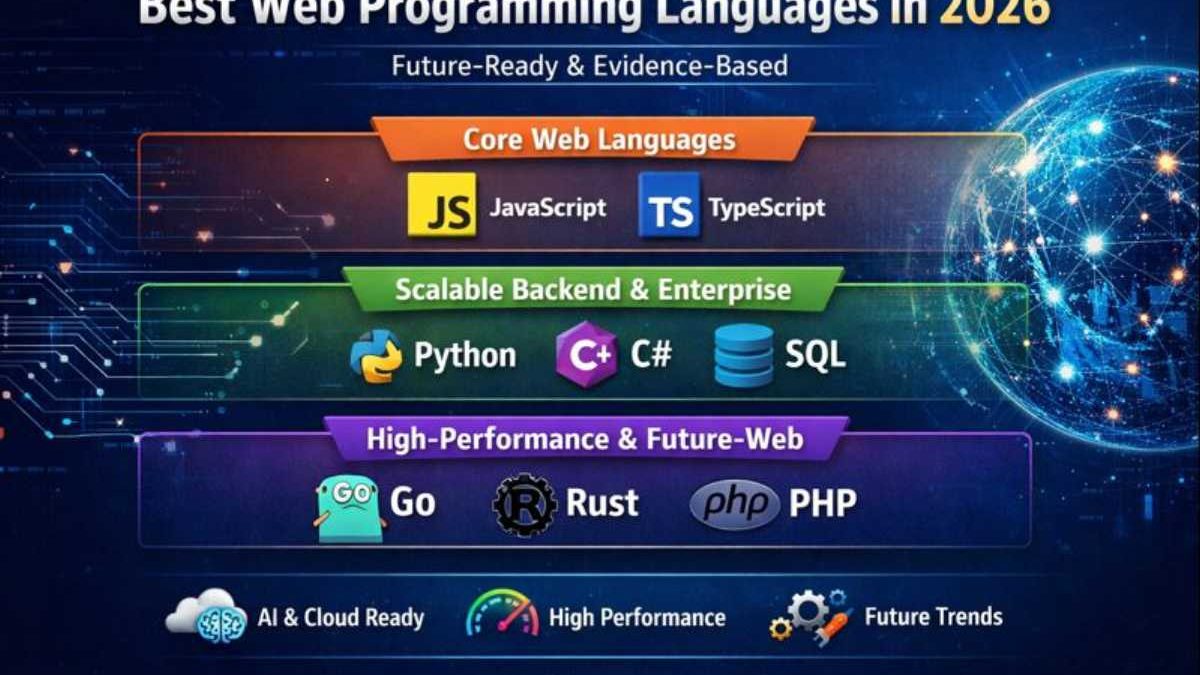
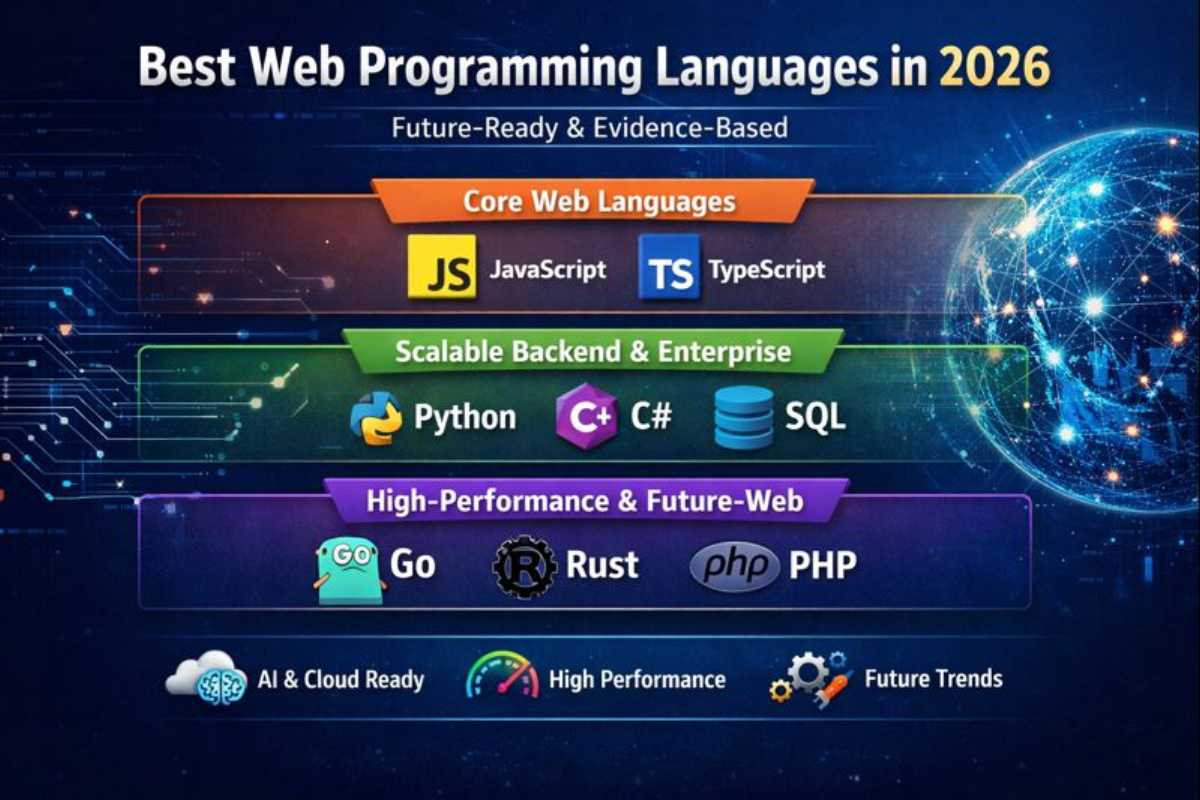
Tier 1: Core Web Languages
These languages form the non-negotiable foundation of the web.
-
JavaScript — The Backbone of the Web
Why it remains essential
- The only language natively supported by all browsers
- Powers frontend, backend, real-time apps, and APIs
- Supported by the largest web ecosystem in history
Modern relevance
JavaScript is no longer “just frontend.” With Node.js, it runs:
- Backend servers
- Serverless functions
- Real-time systems
Real-World Example
Netflix and PayPal rely heavily on JavaScript-based stacks to manage millions of concurrent users.
Key Insight
Even WebAssembly-based apps still rely on JavaScript as the integration layer — making it irreplaceable.
Best for
- Frontend development
- Full-stack applications
- Interactive, real-time web apps
-
TypeScript — The Professional Standard for Web Apps
Why TypeScript matters in 2026
- Adds static typing to JavaScript
- Reduces runtime errors
- Improves large-scale maintainability
Industry reality
Most serious JavaScript projects now default to TypeScript, especially in:
- Enterprise apps
- SaaS platforms
- Open-source frameworks
Business impact
Teams using TypeScript experience:
- Easier onboarding
- Safer refactoring
- Fewer production bugs
Best for
- Large frontend apps
- Full-stack development
- Long-term projects
Tier 2: Scalable Backend & Enterprise Languages
These languages power robust backend systems and data-driven web platforms.
-
Python — The Engine of Intelligent Web Apps
Why Python thrives
- Rapid development speed
- Clean syntax
- Massive ecosystem
Web frameworks
- Django (full-featured)
- FastAPI (high-performance APIs)
- Flask (lightweight services)
Unique 2026 Advantage
Python dominates AI and machine learning, making it ideal for web apps that include:
- Personalization
- Recommendations
- Search intelligence
- Automation
Case Study
Instagram integrates Python-based services for data processing and personalization pipelines.
Best for
- API development
- AI-powered web apps
- Data-driven platforms
-
C# (.NET) — Enterprise-Grade Web Development
Why C# remains strong
- Excellent performance
- Strong security model
- Deep cloud integration (especially Azure)
Modern shift
C# is increasingly used in:
- Microservices
- Cloud-native APIs
- Large SaaS platforms
Often Overlooked Advantage
Strong tooling, long-term support, and predictable maintenance costs make C# attractive for businesses.
Best for
- Enterprise web platforms
- B2B SaaS
- Cloud-based applications
-
SQL — The Most Underrated Web Skill
Why SQL belongs here
Every serious web application relies on structured data.
Reality
Most scalability issues are caused not by language choice, but by:
- Poor database design
- Inefficient queries
Why competitors miss this
SQL isn’t flashy — but it’s critical.
Best for
- Database-driven applications
- Analytics dashboards
- E-commerce platforms
Tier 3: Performance-First & Future-Web Languages
These languages shape the next generation of web architecture.
-
Go (Golang) — Built for Scale
Why Go is rising
- Designed for concurrency
- Simple syntax
- Excellent performance
Typical use cases
- High-traffic APIs
- Microservices
- Cloud infrastructure
Real-World Use
Many cloud platforms use Go for backend services due to efficiency and stability.
-
Rust — Powering the Future via WebAssembly
Why Rust matters
- Memory-safe
- Extremely fast
- Compiles to WebAssembly (WASM)
Why this is important
WASM allows near-native performance inside the browser, enabling:
- Complex data processing
- High-performance visuals
- Secure execution
Key Insight
Rust isn’t replacing JavaScript — it complements it for performance-critical tasks.
-
PHP — Still Relevant, but Purpose-Specific
Why PHP survives
- Powers a massive portion of the web
- Dominant in CMS platforms
Modern reality
With modern frameworks, PHP can still scale — but it’s best suited for:
- Content-driven websites
- Publishing platforms
Best for
- Blogs
- CMS-based websites
- Marketing sites
Comparison Table: Web Goals vs Best Language
| Web Goal | Recommended Languages |
| Frontend UI | JavaScript, TypeScript |
| Full-stack apps | TypeScript + Python |
| High-traffic APIs | Go, C# |
| AI-driven web apps | Python + JavaScript |
| Performance-critical apps | Rust + WASM |
| CMS & content sites | PHP + SQL |
Emerging Trends Most Articles Ignore
-
WebAssembly Is Reshaping Web Performance
Languages like Rust and C# now run inside browsers, unlocking new capabilities.
-
AI Is Becoming a Native Web Feature
Modern web apps increasingly embed:
- Intelligent search
- Automated workflows
- Personalization engines
-
Stack Choice Beats Language Choice
Successful teams choose combinations, not single languages.
Which Web Programming Language Should You Learn?
| Your Goal | Best Choice |
| Beginner | JavaScript → TypeScript |
| Full-stack developer | TypeScript + Python |
| Cloud backend | Go or C# |
| Future-proof skills | JavaScript + Rust |
| Content websites | PHP + SQL |
Key takeaways
- JavaScript and TypeScript are unavoidable
- Python dominates intelligent web systems
- Go and Rust define performance-first architecture
- SQL remains foundational and undervalued
The strongest web developers and businesses don’t chase trends — they build future-ready stack
