
Table of Contents
Introduction
The internet has always evolved in waves. In Web 2.0, companies built centralized platforms that control data, monetization, and user interactions. However, this model has increasingly faced criticism due to privacy concerns, monopolistic control, and lack of transparency.
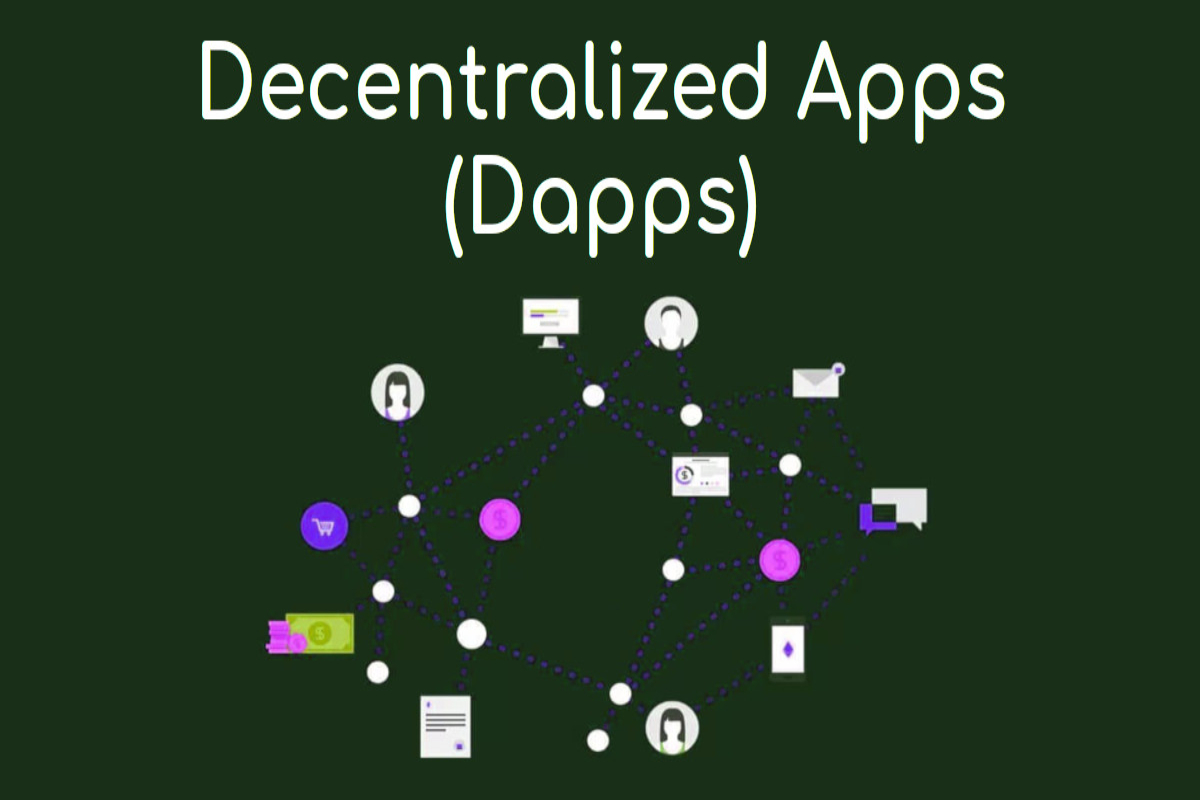
Decentralized applications (dApps) emerge as a response to these limitations. Built on blockchain technology, they eliminate the need for intermediaries and enable direct peer-to-peer interaction. Unlike traditional apps, which rely on centralized servers, dApps operate on distributed networks, making them more resilient and transparent.
This shift is not just technological—it is economic and philosophical. It changes who owns digital assets, who controls platforms, and how value is distributed.
What Are Decentralized Apps (dApps)?
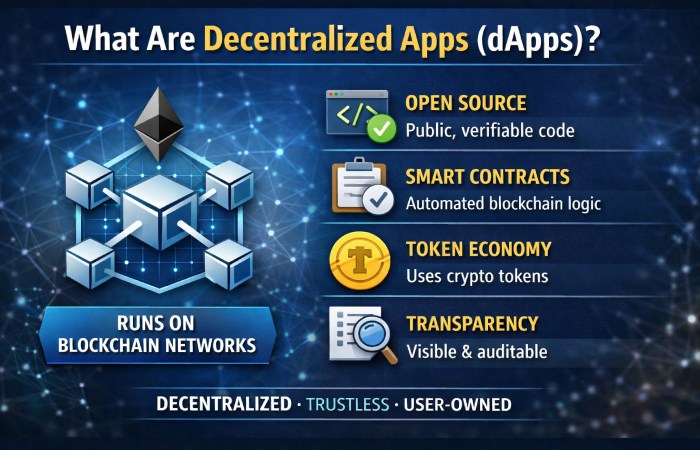
A decentralized application (dApp) is software that runs on a distributed blockchain network rather than a centralized server. These applications use smart contracts to automate processes and enforce rules without human intervention.
Unlike traditional apps, dApps operate autonomously and are governed by code and community consensus instead of a single authority.
Core Characteristics of dApps
| Feature | Explanation | Why It Matters |
| Decentralization | Runs on distributed blockchain nodes | Eliminates single point of failure |
| Open Source | Code is publicly accessible | Builds trust and transparency |
| Smart Contracts | Self-executing logic | Removes intermediaries |
| Tokenization | Uses crypto tokens | Enables new economic models |
| Consensus Mechanisms | Validates transactions | Ensures data integrity |
How Decentralized Apps Work
At a structural level, dApps function similarly to traditional apps but with a fundamentally different backend.
Instead of relying on centralized databases, dApps use blockchain networks where data is stored across multiple nodes. Smart contracts act as the backend logic, automatically executing transactions when conditions are met.
This architecture removes the need for trust in a central authority and replaces it with cryptographic verification.
dApp Architecture Breakdown
| Layer | Component | Description |
| Frontend | UI/UX | Built with web technologies |
| Middleware | Wallets & APIs | Connect users to blockchain |
| Backend | Smart Contracts | Executes logic automatically |
| Infrastructure | Blockchain | Stores and validates data |
Types of Decentralized Applications
dApps are not limited to one use case—they span multiple industries and categories.
-
DeFi (Decentralized Finance)
These dApps allow users to lend, borrow, and trade assets without banks.
-
Gaming dApps
Players can own in-game assets and earn tokens.
-
NFT Platforms
Enable digital ownership of art, music, and collectibles.
-
DAOs (Decentralized Autonomous Organizations)
Community-governed systems where users vote on decisions.
Popular dApp Categories
| Category | Description | Example Use Case |
| DeFi | Financial services without intermediaries | Crypto lending |
| Gaming | Play-to-earn ecosystems | Blockchain games |
| NFTs | Digital ownership | Art marketplaces |
| DAOs | Governance systems | Voting protocols |
| Identity | Self-sovereign identity | Digital ID systems |
Why dApps Matter: Beyond the Hype
Most articles highlight features like “security” or “transparency,” but the deeper value of dApps lies in structural transformation.
-
Trustless Systems
Users do not need to trust a company—the system enforces rules automatically through code.
-
User Ownership
Users control their data, assets, and identities.
-
Censorship Resistance
No central authority can block access or remove content.
-
Global Accessibility
Anyone with internet access can use dApps without permission.
These benefits stem from blockchain’s decentralized nature, which distributes control across the network.
Traditional Apps vs dApps
| Feature | Traditional Apps | dApps |
| Control | Central authority | Distributed network |
| Data Ownership | Company-owned | User-owned |
| Transparency | Limited | High |
| Downtime Risk | High | Low |
| Monetization | Ads & subscriptions | Tokens & incentives |
Advantages of Decentralized Applications
dApps offer several key advantages that make them attractive for the future of digital systems.
Security & Integrity
Blockchain ensures that data is immutable and resistant to tampering.
No Single Point of Failure
Because dApps run on distributed networks, they are less vulnerable to outages or attacks.
Transparency
All transactions are recorded on a public ledger, enabling auditability.
Efficiency
Smart contracts automate processes, reducing costs and delays.
Key Benefits Summary
| Benefit | Impact | Example |
| Security | Reduced hacking risk | Immutable records |
| Transparency | Public auditability | Open ledgers |
| Efficiency | Faster transactions | Automated contracts |
| Accessibility | Global access | No intermediaries |
| Ownership | User control | Crypto wallets |
Challenges and Limitations of dApps
Despite their advantages, dApps are not without limitations. In fact, these challenges are the biggest barrier to mainstream adoption.
-
Scalability Issues
Blockchain networks struggle with high transaction volumes, leading to slow speeds and high fees.
-
User Experience (UX)
Wallets, private keys, and gas fees create friction for beginners.
-
Regulatory Uncertainty
Governments are still defining how to regulate decentralized systems.
-
Security Risks
Smart contract bugs can lead to irreversible losses.
Key Limitations Overview
| Challenge | Description | Impact |
| Scalability | Limited throughput | Slow performance |
| Gas Fees | Cost of transactions | Expensive usage |
| Complexity | Difficult onboarding | Low adoption |
| Regulation | Legal uncertainty | Market hesitation |
| Irreversibility | No rollback | High risk |
Real-World Use Cases of dApps
dApps are already transforming multiple industries by removing intermediaries and increasing efficiency.
Finance (DeFi)
Decentralized finance platforms enable peer-to-peer lending and trading without banks.
Supply Chain
Blockchain ensures transparency and traceability in logistics.
Social Media
Users own their content and data.
Identity Management
Users control their digital identity without relying on centralized systems.
Industry Transformation
| Industry | Traditional Model | dApp Model |
| Finance | Bank-controlled | Peer-to-peer |
| Gaming | Company-owned assets | Player-owned assets |
| Media | Platform monetization | Creator monetization |
| Identity | Central databases | Self-sovereign identity |
The Economics of dApps: What Most Content Misses
Here’s the critical insight:
dApps are not just applications—they are economic systems.
Traditional apps monetize through ads, subscriptions, or data extraction. dApps, however, use tokens to align incentives between users, developers, and investors.
This creates a new model where:
- Users become stakeholders
- Developers earn through protocol growth
- Communities govern platforms
This token-based economy is what differentiates dApps from traditional software.
Web2 vs Web3 Economic Models
| Aspect | Web2 Apps | dApps (Web3) |
| Revenue Model | Ads & subscriptions | Token incentives |
| Ownership | Centralized | Distributed |
| Governance | Company decisions | Community voting |
| Value Distribution | Platform keeps majority | Shared with users |
Future of Decentralized Applications
The future of dApps depends on solving key technological and usability challenges.
-
Layer 2 Scaling
Solutions like rollups aim to improve speed and reduce costs.
-
Interoperability
Different blockchains need to communicate seamlessly.
-
Better UX
Simplifying wallets and onboarding will drive adoption.
-
Regulation Clarity
Clear frameworks will encourage institutional adoption.
Emerging Trends in dApps
| Trend | Description | Impact |
| Layer 2 Scaling | Faster transactions | Mass adoption |
| Cross-chain Tech | Blockchain interoperability | Ecosystem growth |
| AI Integration | Smart automation | Enhanced functionality |
| Decentralized Identity | User-controlled credentials | Privacy protection |
How to Get Started with dApps
For beginners, interacting with dApps can seem complex—but it can be simplified into a few steps.
Step-by-Step Guide
| Step | Action | Tools Needed |
| 1 | Create a crypto wallet | MetaMask |
| 2 | Buy cryptocurrency | Exchange |
| 3 | Connect wallet to dApp | Browser wallet |
| 4 | Start transactions | Tokens |
| 5 | Learn gas fees | Blockchain explorer |
Best Practices for Using dApps
To safely interact with decentralized applications:
- Verify smart contract addresses
- Avoid unknown platforms
- Use hardware wallets for security
- Start with small transactions
Security Checklist
| Practice | Purpose |
| Use hardware wallet | Protect private keys |
| Verify URLs | Avoid phishing |
| Check audits | Ensure smart contract safety |
| Backup wallet | Prevent loss |
Conclusion
Decentralized applications are still evolving, but their impact is already visible across industries. They offer a new model of trust, ownership, and governance that challenges traditional digital systems. However, mass adoption will depend on usability, scalability, and regulatory clarity—not just technological innovation.
