
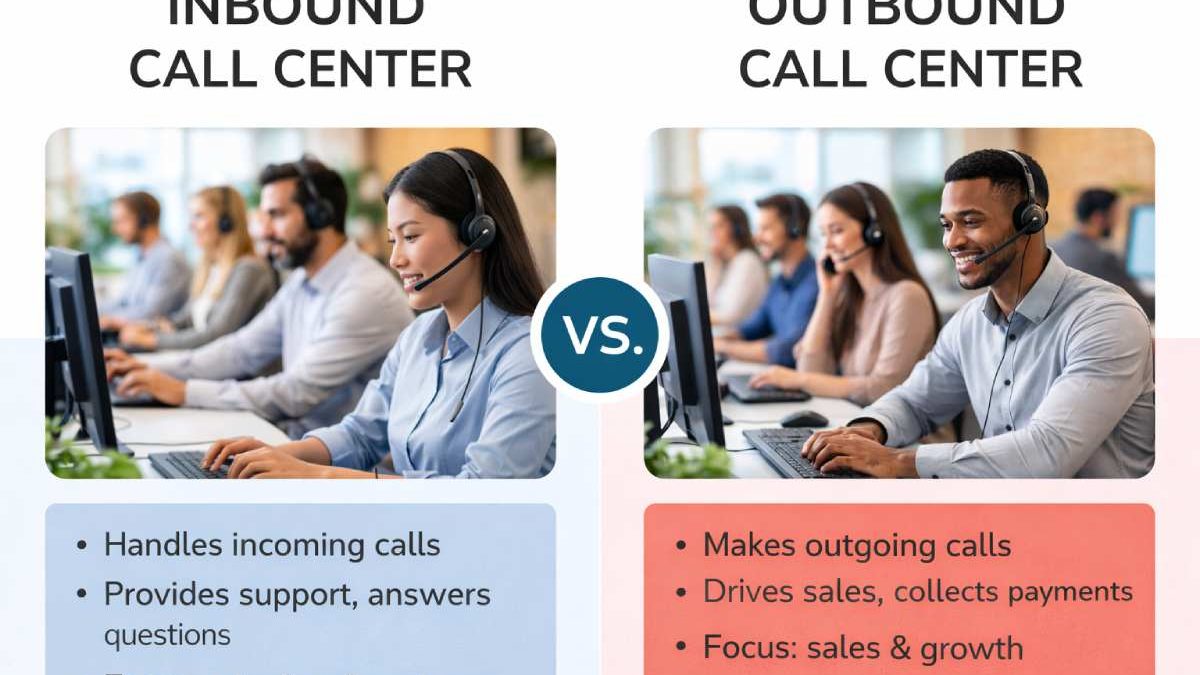
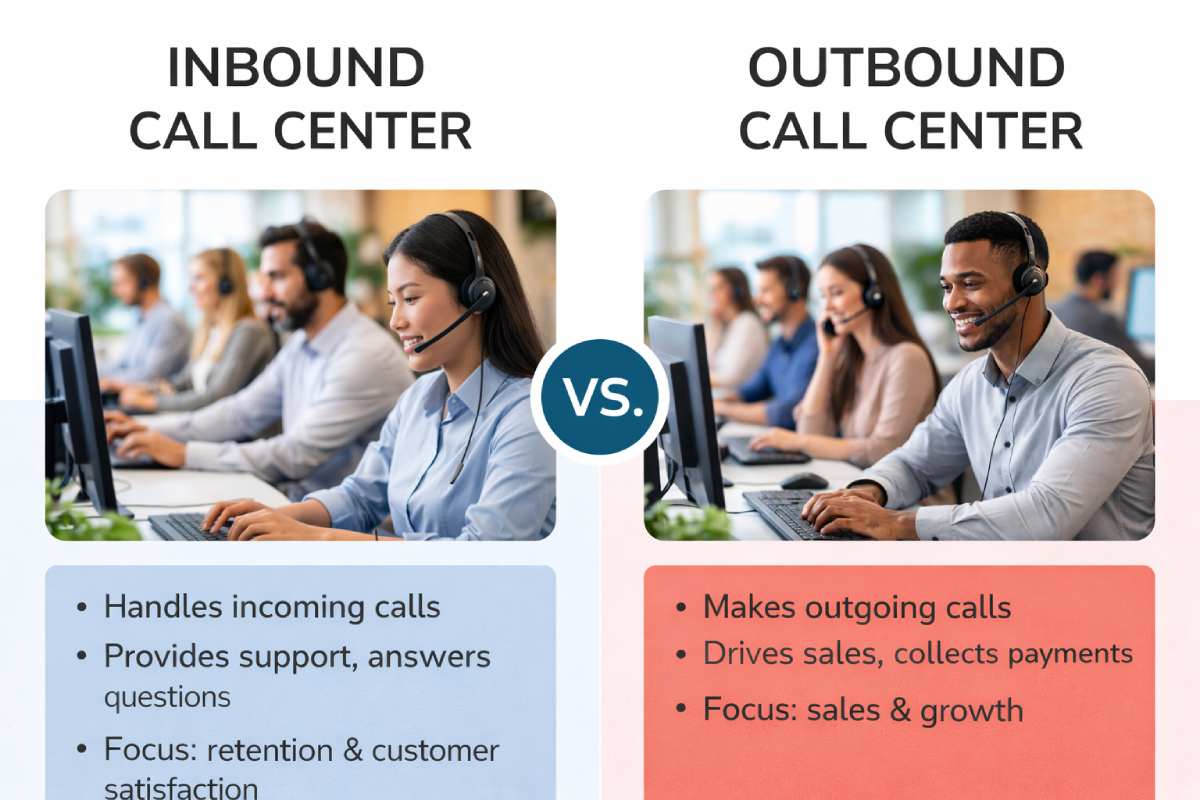
The difference between inbound and outbound call centers is a strategic choice between protecting existing revenue and generating new revenue. Understanding how each model affects costs, KPIs, staffing, and risk is essential for building a scalable customer operation.
Most businesses think this topic is simple. Inbound handles support. Outbound handles sales. End of story.
That assumption is exactly why companies overspend, underperform, and misjudge their customer strategy.
Here is the clear answer upfront:
Inbound call centers manage customer-initiated interactions and are designed to retain value and protect brand trust. Outbound call centers initiate contact to create new value through sales, expansion, or recovery. The right choice depends on whether your immediate challenge is churn or growth.
If your customers are frustrated, launching outbound sales campaigns won’t solve the real issue. If your support is excellent but your pipeline is empty, doubling down on inbound won’t drive expansion.
It is not for readers looking for a quick definition only. We’ll go deeper into strategy, cost logic, staffing psychology, and risk exposure.
Table of Contents
What Is an Inbound Call Center?

An inbound call center handles calls initiated by customers. The interaction begins becausethe customer needs something: help, clarification, or resolution.
Inbound is reactive operationally — but proactive strategically. It prevents dissatisfaction from turning into churn.
Common Inbound Functions
| Function | Customer Intent | Business Objective | Revenue Impact |
| Technical Support | Fix issue | Prevent churn | Protects existing revenue |
| Billing Inquiry | Clarify charge | Build trust | Reduces disputes |
| Order Assistance | Complete purchase | Improve conversion | Direct |
| Complaint Handling | Express dissatisfaction | Restore satisfaction | Protects brand |
| Account Questions | Understand product | Increase usage | Boost retention |
Inbound teams sit in the post-purchase phase of the lifecycle. Research from Gartner consistently highlights customer experience as a primary retention driver. Inbound operations influence that experience daily.
Inbound KPI Framework
Inbound performance is not measured by revenue closed. It is measured by service quality and efficiency.
| KPI | Why It Matters | Strategic Meaning |
| CSAT (Customer Satisfaction) | Measures satisfaction | Loyalty predictor |
| FCR (First Call Resolution) | Issue solved on first contact | Reduces frustration |
| AHT (Average Handle Time) | Efficiency metric | Cost control |
| Service Level | Speed of response | Accessibility |
| Abandonment Rate | Dropped calls | Demand misalignment |
Inbound success = retention stability.
If inbound fails, outbound becomes more expensive because you are acquiring customers only to lose them.
What Is an Outbound Call Center?
An outbound call center initiates contact with prospects or existing customers. The business drives the interaction.
Outbound is proactive and growth-oriented. It pushes opportunity rather than responding to it.
Common Outbound Functions
| Function | Target Audience | Primary Goal | Revenue Role |
| Cold Calling | New prospects | Acquire customers | Direct |
| Lead Qualification | Interested prospects | Filter quality | Pipeline |
| Appointment Setting | Decision-makers | Enable sales team | Indirect |
| Win-Back Campaigns | Churned customers | Recover revenue | High leverage |
| Collections | Overdue accounts | Recover cash | Cash flow |
Outbound sits in the acquisition and expansion stages of the lifecycle.
Outbound KPI Framework
Outbound success is measured by performance and profitability.
| KPI | Why It Matters | Strategic Meaning |
| Conversion Rate | % of sales closed | Sales effectiveness |
| Calls per Hour | Productivity | Efficiency |
| Contact Rate | Reach quality | Data quality indicator |
| CPA (Cost per Acquisition) | Customer cost | Profitability |
| Revenue per Agent | Output value | ROI clarity |
Outbound success = measurable revenue creation.
But it is also more volatile. Poor targeting or aggressive scripts can increase complaints and regulatory risk.
Strategic Comparison: Retention Engine vs Growth Engine
Most articles reduce this topic to operational differences. The real difference is strategic positioning.
| Dimension | Inbound | Outbound |
| Lifecycle Stage | Post-purchase | Pre-purchase |
| Revenue Role | Protects | Creates |
| Customer Mood | Needs help | May be resistant |
| Risk Profile | Lower | Higher |
| Budget Type | Operational | Performance-driven |
| Brand Impact | Experience shaping | Perception shaping |
Inbound strengthens existing value. Outbound expands total value.
If you confuse these roles, you misallocate budget.
Cost Structure Comparison
Cost logic differs significantly between models.
| Cost Element | Inbound | Outbound |
| Staffing Model | Stable headcount | Campaign-based |
| Training Focus | Product knowledge | Sales psychology |
| Tech Stack | IVR, ticketing systems | Dialers, CRM automation |
| Data Costs | Minimal | Often significant |
| Turnover Rate | Moderate | Higher |
| ROI Visibility | Indirect | Direct |
Inbound costs resemble infrastructure. Outbound costs resemble investment bets.
Staffing & Psychological Demands
People often underestimate how different these teams feel culturally.
| Factor | Inbound Agents | Outbound Agents |
| Emotional Intelligence | Very high | Moderate |
| Objection Handling | Moderate | Very high |
| Rejection Exposure | Low | High |
| Customer Frustration Exposure | High | Moderate |
| Burnout Risk | Emotional fatigue | Performance pressure |
Studies from Deloitte on workforce trends highlight higher attrition in high-pressure sales environments — which aligns with outbound call centers.
Compliance & Regulatory Risk
Outbound operations face significantly more regulatory oversight.
| Region | Key Outbound Risk | Inbound Risk Level |
| United States | Do Not Call Registry | Low |
| European Union | GDPR consent requirements | Low |
| UK | PECR marketing restrictions | Low |
| India | TRAI telemarketing rules | Moderate |
Outbound requires stronger legal review, especially in finance and healthcare sectors.
Inbound typically carries fewer compliance challenges because the customer initiates contact.
Industry Use Cases
Different industries lean differently on each model.
| Industry | Inbound Priority | Outbound Priority |
| E-commerce | Returns & support | Promotions |
| B2B SaaS | Onboarding & support | Demo booking |
| Healthcare | Appointment booking | Reminder calls |
| Finance | Account service | Loan offers |
| Telecom | Technical issues | Plan upgrades |
Illustrative Scenario Comparison
Scenario 1: High Churn SaaS Startup
- Churn rate rising
- Customer complaints increasing
- Sales team pushing outbound aggressively
Correct move: Strengthen inbound support first.
If retention improves, outbound becomes more profitable.
Scenario 2: Mature Retail Brand
- Strong repeat customers
- Slowing new customer growth
- Stable support metrics
Correct move: Invest in outbound campaigns to expand reach.
Hybrid Call Centers: The Modern Mode
Modern enterprises integrate both functions into unified contact centers.
Hybrid systems:
- Use inbound data to personalize outbound outreach
- Trigger follow-ups automatically
- Align support insights with sales strategies
- Maintain consistent messaging across channels
Research from McKinsey & Company shows integrated customer operations outperform siloed structures in long-term profitability.
Decision Framework: Which Model Do You Need?
Use this evaluation table:
| Business Condition | Recommended Focus |
| High customer complaints | Inbound |
| High churn | Inbound |
| Weak sales pipeline | Outbound |
| Low brand awareness | Outbound |
| Strong retention + slow growth | Hybrid |
| Mature enterprise scaling globally | Hybrid |
Future Trends: AI and Automation
AI is changing both models:
| Technology | Inbound Impact | Outbound Impact |
| AI Chatbots | Reduce routine calls | Pre-qualify leads |
| Predictive Dialers | Not primary | Boost efficiency |
| Sentiment Analysis | Improve service quality | Refine scripts |
| CRM Automation | Faster resolution | Smarter targeting |
The future is not inbound vs outbound — it is integrated customer engagement.
Common Misconceptions
| Myth | Reality |
| Inbound does not generate revenue | It protects lifetime value |
| Outbound is just cold calling | It includes lifecycle outreach |
| You must choose one | Most scalable businesses use both |
| Inbound is easier | Emotional labor is intense |
| Outbound is always aggressive | Modern outreach is data-driven |
Final Verdict
Inbound call centers protect what you already earned. Outbound call centers build what you want to earn next. Choosing between them is not about definitions. It is about lifecycle alignment, risk tolerance, budget strategy, and growth ambition. The smartest organizations do not ask “Which is better?” They ask, “What stage of growth are we in — and which engine do we need right now?”
