

Coperewards.com is not just about earning small rewards—it represents a trade-off between time, data, and value, and should be evaluated based on efficiency rather than just legitimacy.
Most people searching for Coperewards.com want a simple answer: Is it legit or a scam?
Here’s the direct answer: it may function as a real reward platform, but for most users, it is not a worthwhile way to earn meaningful money.
The real issue is not access—it’s expectations. Platforms like this are designed to look simple and rewarding, but the underlying system ensures that users receive only a small fraction of the value they generate. This creates a common cycle: initial excitement, followed by confusion, and eventually disappointment.
If you approach Coperewards.com with the wrong mindset—expecting consistent income—you will likely feel it’s a waste of time. But if you understand how it works and where it fits in the broader online economy, you can make a smarter decision about whether to use it at all.
Table of Contents
What is Coperewards.com?
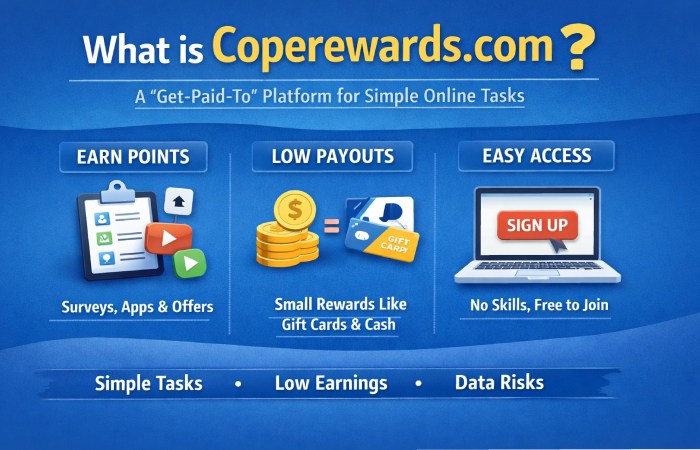
Coperewards.com appears to be part of the “Get-Paid-To” (GPT) ecosystem—a category of platforms that reward users for completing simple digital tasks.
These platforms are built around accessibility. Anyone with an internet connection can sign up and start earning without needing experience, qualifications, or tools. That’s why they attract beginners.
However, the simplicity comes at a cost: low-value work leads to low-value rewards.
| Feature | Explanation | Impact on User |
| No skill requirement | Tasks are simple and repetitive | Easy entry but low pay |
| Task-based system | Paid per action (survey, click, install) | Income depends on volume |
| Points system | Rewards are converted from points | Reduces transparency |
| Third-party offers | Tasks come from external networks | Less control and reliability |
From a structural perspective, Coperewards.com is not unique—it operates similarly to many reward platforms in the global digital advertising ecosystem.
How Coperewards.com Works
Understanding the process helps explain why users often feel the rewards are not worth the effort.
Step-by-Step Flow
| Step | What Happens | Hidden Reality |
| Sign-up | Create account and log in | Quick and frictionless |
| Browse tasks | Choose from surveys or offers | Many tasks have conditions |
| Complete task | Follow instructions | Risk of disqualification |
| Earn points | Points added to account | May not always track correctly |
| Withdraw | Convert points to rewards | Threshold delays payout |
Task Types Explained
| Task Type | Description | Common Issue |
| Surveys | Answer questions for market research | Disqualification midway |
| App installs | Download and use apps | Tracking failures |
| Sign-up offers | Register for services | Hidden requirements |
| Video tasks | Watch ads or clips | Very low payouts |
Illustrative Example:
You spend 2 hours completing surveys and offers. Out of 5 attempts:
- 2 surveys disqualify you
- 1 task fails to track
- 2 tasks reward small points
Your total earnings may be far lower than expected.
The Business Model Explained
The most important insight is understanding where the money comes from—and where it goes.
| Participant | Role | Earnings Share |
| Advertiser | Pays for user action | Highest |
| Offer Network | Connects platform and advertiser | Medium |
| Platform (Coperewards) | Hosts tasks | Medium |
| User | Completes tasks | Lowest |
This structure is consistent with digital advertising models discussed by organizations like Statista and Nielsen, where user attention and data are monetized at scale.
Digital advertising involves businesses paying to reach audiences through different channels, including websites, apps, and public advertising spaces. For an overview of an offline advertising approach, explore these five types of transit advertising and how to use them effectively.
Why Earnings Are Structurally Low
| Factor | Explanation | Result |
| Revenue split | Multiple layers take a cut | Reduced user earnings |
| Task pricing | Advertisers optimize cost | Low payouts |
| User supply | High number of users | Lower value per user |
| Automation | Tasks require minimal skill | Low compensation |
This is not a flaw—it’s how the system is designed.
Time vs Value Analysis
Most users focus on earning, but the smarter approach is evaluating earning efficiency.
| Activity | Time Invested | Short-Term Earnings | Long-Term Value |
| Reward platforms | High | Low | None |
| Freelancing | Medium | Medium | High |
| Skill learning | Medium | Low initially | Very High |
According to productivity insights from Harvard Business Review, high-value work compounds over time, while low-skill repetitive tasks do not.
Practical Comparison Scenario
| Scenario | Hours Spent | Outcome |
| Coperewards tasks | 10 hours | Small payout |
| Learning a skill | 10 hours | Future earning ability |
| Freelance work | 10 hours | Immediate higher income |
This comparison highlights the opportunity cost—what you give up by choosing one option over another.
Is Coperewards.com Legit or a Scam?
Instead of a yes/no answer, evaluate it using structured criteria.
Trust Evaluation
| Factor | What to Check | Why It Matters |
| Transparency | Company details, policies | Indicates legitimacy |
| Payment proof | User feedback | Shows reliability |
| Support | Response time | Builds trust |
| Terms | Clear conditions | Prevents surprises |
A platform can be technically “legit” but still not worth using.
Risks and Red Flags
| Red Flag | Meaning | Risk Level |
| Unrealistic income claims | Marketing exaggeration | High |
| Frequent redirects | Third-party dependency | Medium |
| Data-heavy tasks | Personal info usage | High |
| Delayed payouts | Cash flow control | Medium |
Data Privacy Considerations
Platforms like Coperewards.com often rely on user data. Regulations such as the General Data Protection Regulation highlight the importance of transparency, but enforcement varies globally.
If you are in regions with weaker enforcement, you should be extra cautious about:
- Sharing personal details
- Downloading unknown apps
- Accepting unclear terms
Pros vs Cons
| Pros | Cons |
| Easy to start | Very low earnings |
| No skill required | High time investment |
| Flexible usage | Frequent disqualifications |
| Beginner-friendly | Privacy concerns |
The pattern is clear: accessibility is high, but value is low.
Who Should Use Coperewards.com?
| User Type | Recommendation | Reason |
| Beginners | Yes (limited use) | Learning experience |
| Casual users | Maybe | Spare time usage |
| Professionals | No | Poor time efficiency |
| Privacy-focused users | No | Data risks |
Better Alternatives
One alternative to repetitive reward tasks is to develop a marketable skill that can lead to paid projects. Graphic design is one such option for people interested in visual communication, branding, and digital content. Explore graphic design jobs to learn more about potential career opportunities.
| Option | Effort | Income Potential | Key Advantage |
| Freelancing | Medium | High | Skill-based income |
| Content creation | High | Very High | Scalable growth |
| Affiliate marketing | Medium | High | Passive income potential |
Moving beyond low-value online tasks often involves exploring new ideas, developing useful skills, and finding more effective ways to solve problems. For a broader perspective on creative thinking and innovative approaches, read about ProjectRethink.org.
Strategic Comparison
| Model | Income Type | Scalability | Stability |
| Reward platforms | Fixed per task | None | Low |
| Freelancing | Per project | Medium | Medium |
| Digital assets | Passive | High | High |
This shift—from tasks to skills—is where real growth happens.
Strategic Insight: When to Quit Reward Platforms
| Signal | Meaning | Action |
| Low hourly rate | Time undervalued | Stop using |
| No skill growth | No future benefit | Switch strategy |
| High frustration | Poor experience | Exit early |
Final Thoughts
Coperewards.com is not inherently dangerous—it’s simply often misunderstood. If you choose to use it, approach it as a short-term experiment rather than a long-term strategy. Set clear limits on how much time you spend, and be mindful about the personal information you share while completing tasks. Most importantly, don’t confuse being busy with making real progress. The true shift happens when you move beyond completing small tasks and start creating real value, and when you transition from earning minor rewards to building sustainable income systems. That shift is what separates staying stuck from actually growing.