
Free-to-play slots are not realistic practice tools—they reshape how players perceive risk, rewards, and decision-making. Used intentionally, they can teach mechanics and behavior; used casually, they create misleading confidence.
Most people approach free-to-play slots believing they are a safe training ground before risking money. That assumption is incomplete. While there is no financial loss, there is also no real pressure—and that changes everything about how decisions are made. The result is a hidden mismatch: players learn how games work, but not how they themselves behave under risk.
Free-to-play slots are useful for understanding mechanics and volatility, but they are unreliable for preparing you for real-money gameplay.
If used without structure, they can actually create habits that lead to worse outcomes later. If used with intention, they can give you a strong conceptual foundation—without costing you anything.
Table of Contents
Why Free-to-Play Slots Feel Easier Than They Really Are
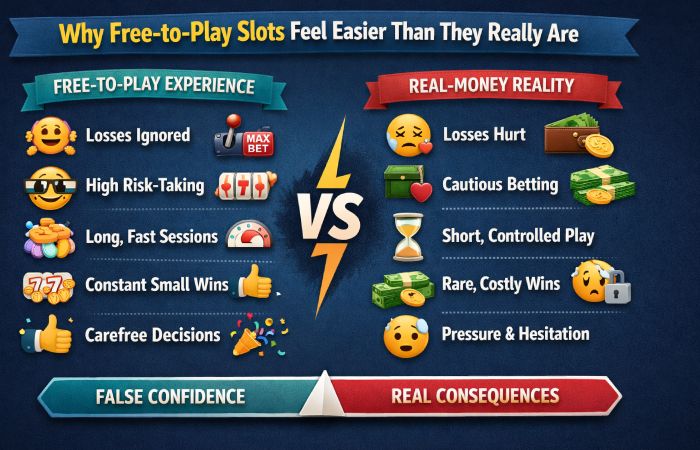
Free-to-play slots feel easier because they eliminate the consequences that normally shape behavior. Without financial loss, your brain processes outcomes differently—you take more risks, recover instantly from losses, and continue playing without hesitation.
In addition, many slot designs emphasize engagement. This includes frequent small wins, visually stimulating feedback, and uninterrupted play cycles. These elements create a smooth, rewarding experience that feels more successful than it actually is.
Perception vs Reality
| Aspect | Free-to-Play Experience | Real-Money Reality |
| Loss perception | Ignored instantly | Emotionally impactful |
| Risk-taking | High and impulsive | Cautious or reactive |
| Session length | Long, uninterrupted | Shorter, more controlled |
| Win satisfaction | Inflated | Context-dependent |
| Decision speed | Fast and careless | Slower, pressured |
Example Scenario
| Scenario | Free Play | Real Money |
| Spins | 500 spins | 50 spins |
| Emotional state | Neutral or excited | Tension increases |
| Betting behavior | Aggressive | Hesitant |
| Outcome perception | “I’m doing well” | “I need to be careful” |
The mechanics are identical, but the psychological environment is completely different. This is the first major misunderstanding beginners must overcome.
What Free-to-Play Slots Actually Teach You
Free play is not useless—it simply has a limited scope of value.
Learning Scope Breakdown
| Category | What You Learn | Depth of Learning | Real-World Value |
| Game mechanics | Reels, paylines, symbols | High | High |
| Bonus features | Triggers and effects | High | High |
| Volatility | Win frequency vs payout size | Medium | High |
| Bankroll management | Not experienced | None | Critical |
| Emotional discipline | Not experienced | None | Critical |
| Loss tolerance | Not experienced | None | Critical |
Key Insight
Free play teaches systems, not behavior.
This distinction matters because most real-world outcomes depend more on behavior than on understanding mechanics. Knowing how a slot works does not mean you will make good decisions when money is involved.
The Psychology Behind Free Play
Free-to-play slots are powerful because they influence how your brain interprets risk and reward.
Behavioral Effects Overview
| Psychological Factor | What Happens in Free Play | Long-Term Impact |
| Risk detachment | Losses feel meaningless | Encourages reckless habits |
| Reward conditioning | Frequent small wins | Builds false confidence |
| Illusion of control | Belief in patterns | Misinterpretation of randomness |
| Overexposure | Long sessions | Reduced decision quality |
Research in behavioral science, including work referenced by the American Psychological Association, shows that perceived risk directly affects decision-making quality. When risk is removed, discipline declines.
Similarly, habit formation research from institutions like Stanford University suggests that frequent rewards—even small ones—reinforce repeated behavior. Free-to-play slots are structured in a way that aligns with these principles.
Cognitive Bias in Action
| Bias | Description | How It Appears in Slots |
| Illusion of control | Belief you can influence outcomes | “This machine is paying more” |
| Gambler’s fallacy | Expecting reversal after losses | “A win is due soon” |
| Confirmation bias | Noticing wins more than losses | Remembering jackpots, ignoring losses |
These biases are natural—but free play amplifies them because there is no penalty for being wrong.
Free Play vs Real Money: The Reality Gap
The biggest mistake beginners make is assuming free play is a scaled-down version of real play. It’s not. It’s a different environment entirely.
Core Differences
| Factor | Free Play | Real Money |
| Risk | None | Financial loss |
| Emotional intensity | Low | High |
| Decision-making | Careless | Pressure-driven |
| Behavior | Experimental | Defensive or reactive |
| Learning type | Mechanical | Behavioral + emotional |
Outcome Comparison
| Player Behavior | Free Play Outcome | Real-Money Outcome |
| Increasing bets after wins | Feels rewarding | Leads to volatility risk |
| Chasing losses | No consequence | Accelerated losses |
| Long sessions | Harmless | Financial drain |
The gap is not about the game—it’s about how you respond to it.
Understanding Core Slot Mechanics Without Misinterpretation
To use free play effectively, you need to understand what the core mechanics actually mean—and what they don’t.
RNG (Random Number Generator)
| Truth | Misconception |
| Every spin is independent | “The game is due for a win” |
| No memory exists | “It hasn’t paid in a while” |
| Outcomes are random | “I can spot patterns” |
Regulators like the UK Gambling Commission ensure that certified slot systems operate on true randomness. This means outcomes cannot be predicted or influenced.
RTP (Return to Player)
| Aspect | Reality |
| Definition | Long-term payout percentage |
| Timeframe | Thousands or millions of spins |
| Short sessions | Highly variable outcomes |
| Free play impact | Misleading perception |
Short sessions—especially in free play—do not reflect RTP accurately. This is why players often feel a game is “generous” or “tight” based on limited experience.
Volatility (Variance)
| Volatility Level | Experience |
| Low | Frequent small wins |
| Medium | Balanced gameplay |
| High | Rare large payouts |
Volatility is the one concept that translates well from free play because it affects short-term experience.
A Smarter Way to Use Free-to-Play Slots
If you treat free play casually, it teaches you very little. If you treat it as a structured exercise, it becomes valuable.
4-Phase Learning Framework
| Phase | Focus | Actions | Outcome |
| Exploration | Understanding games | Try multiple slots | Mechanical familiarity |
| Pattern Awareness | Observing behavior | Track win frequency | Volatility insight |
| Simulation | Creating constraints | Set fake bankroll (₹5,000) | Discipline practice |
| Reflection | Evaluating decisions | Review behavior | Self-awareness |
Simulation Example
| Parameter | Value |
| Starting credits | ₹5,000 |
| Spin limit | 100 spins |
| Bet size | Fixed |
| Stop condition | Lose 50% or gain 30% |
This introduces artificial pressure, making the experience more realistic.
Common Beginner Mistakes
Most mistakes are not random—they are predictable outcomes of free-play conditioning.
Mistake Analysis
| Mistake | Cause | Consequence |
| Treating wins as skill | Reward conditioning | Overconfidence |
| Ignoring volatility | Focus on frequency | Misjudging risk |
| Overplaying sessions | No financial limit | Poor habits |
| Chasing excitement | Engagement design | Loss of control |
Understanding the cause helps you correct the behavior.
Advanced Insight: Why Even Intermediate Players Get It Wrong
Even experienced users are affected by free-play distortions.
Hidden Effects
| Factor | Impact |
| Time distortion | Longer sessions than intended |
| Decision fatigue | Declining judgment over time |
| Pattern illusion | Misreading randomness |
Example
| Situation | Outcome |
| 2-hour free session | No perceived cost |
| 2-hour real session | Significant financial exposure |
The difference is not time—it’s consequence.
When Free-to-Play Slots Are Actually Useful
Free slots have a clear but limited purpose.
Best Use Cases
| Use Case | Benefit |
| Learning mechanics | Understand how games function |
| Testing new slots | Explore without risk |
| Comparing volatility | Identify preferred styles |
| Practicing limits | Simulate discipline |
Poor Use Cases
| Misuse | Risk |
| Predicting outcomes | False expectations |
| Developing strategies | Ineffective learning |
| Building confidence | Misleading mindset |
Conclusion
Free-to-play slots remove financial risk—but they also remove the very element that makes decision-making meaningful: consequence.
The smartest approach is not to chase wins, but to observe patterns, understand mechanics, and reflect on your behavior. Because in the end, success in this space is not about predicting outcomes—it’s about understanding the system clearly before engaging with real stakes.
