
SEO success in 2026 depends on building authority, trust, and intent-driven content ecosystems that AI-powered search engines prioritize and recommend.
Most businesses still treat SEO like a checklist—add keywords, build backlinks, publish blogs—and then wonder why traffic doesn’t convert. The problem isn’t effort; it’s misalignment with how modern search actually works.
Today, platforms like Google Search don’t just rank pages—they select answers using AI systems such as Google Gemini. That means the goal has shifted from “ranking #1” to being the most trusted, structured, and useful source.
The best SEO strategies today combine intent mapping, topical authority, technical excellence, and trust signals into a unified system that drives both visibility and revenue.
Table of Contents
Why Most SEO Strategies Fail Today
The majority of SEO failures come from applying outdated frameworks to a rapidly evolving search environment. Businesses still focus heavily on rankings and traffic volume, ignoring whether those visitors actually convert.
This disconnect leads to a frustrating pattern: traffic grows, but revenue stagnates. The root cause is a lack of alignment between SEO activities and real business objectives. Instead of targeting high-intent users, companies chase broad keywords that attract unqualified visitors.
Another major issue is content fragmentation. Publishing dozens of unrelated blog posts without a cohesive strategy weakens authority signals. Search engines now evaluate how deeply you cover a topic, not how often you publish.
Common SEO Failures vs Modern Reality
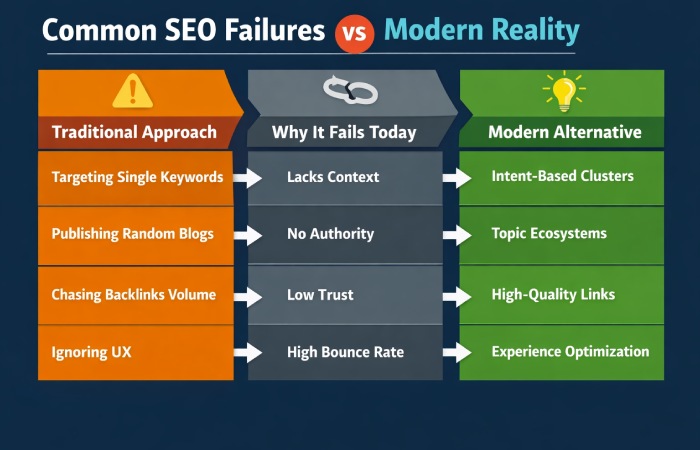
| Traditional Approach | Why It Fails Today | Modern Alternative |
| Targeting single keywords | Lacks context | Intent-based clusters |
| Publishing random blogs | No authority | Topic ecosystems |
| Chasing backlinks volume | Low trust | High-quality links |
| Ignoring UX | High bounce rate | Experience optimization |
The Modern SEO Growth Framework
SEO today works best when treated as a system rather than a tactic. This system is built on four interconnected pillars that directly influence business growth.
The 4 Pillars of SEO Growth
| Pillar | Definition | Key Actions | Business Impact |
| Search Intent | Understanding why users search | Intent mapping | Higher conversions |
| Content Authority | Covering topics deeply | Content clusters | Better rankings |
| Technical SEO | Optimizing performance | Speed, indexing | Improved UX |
| Trust Signals | Building credibility | Backlinks, branding | Increased visibility |
SEO Activities vs Business Outcomes
| SEO Activity | Immediate Effect | Long-Term Impact |
| Keyword optimization | Better rankings | Sustainable traffic |
| Content creation | Engagement | Authority growth |
| Technical fixes | Faster site | Lower bounce rate |
| Link building | Trust signals | Higher domain strength |
Intent-Driven Keyword Mapping
Modern SEO starts with understanding why users search, not just what they type.
Search engines interpret context, meaning that targeting exact keywords without intent alignment leads to poor performance. Instead, businesses should organize keywords into intent-based groups that reflect user needs.
Search Intent Framework
| Intent Type | User Goal | Content Format | Example Use Case |
| Informational | Learn | Blog, guide | “What is SEO?” |
| Commercial | Compare | Reviews, lists | “Best SEO tools” |
| Transactional | Buy | Landing pages | “SEO services pricing” |
Keyword Strategy Comparison
| Approach | Outcome | Limitation |
| Single keyword targeting | Narrow reach | Misses context |
| Long-tail keywords | Better targeting | Limited scale |
| Intent clusters | Full coverage | Requires planning |
Execution Plan
Use tools like Ahrefs or SEMrush to:
- Identify keyword groups
- Map them to intent stages
- Build pages that fully answer user needs
Example:
Instead of writing multiple similar articles, create one comprehensive resource that addresses all variations of a query.
Build Topical Authority Ecosystems
Topical authority is the foundation of modern SEO success. It means becoming a trusted source for an entire subject area, not just individual keywords.
Content Cluster Model
| Component | Role | Example |
| Pillar Page | Main topic | SEO strategies guide |
| Supporting Pages | Subtopics | Keyword research, backlinks |
| Internal Links | Connections | Link all pages together |
Topical Authority vs Traditional Content
| Approach | Strength | Weakness |
| Isolated articles | Quick publishing | Weak authority |
| Topic clusters | Strong relevance | Requires structure |
Why This Works
AI systems pull answers from comprehensive, interconnected content. This increases the chances of your content being cited in summaries and featured results. Internal link opportunity: Add a detailed guide on content clustering.
Create AI-Optimized Content
Content must now be optimized not just for users, but also for AI interpretation and extraction.
AI-Friendly Content Elements
| Element | Description | Benefit |
| Structured headings | Clear sections | Easier parsing |
| Tables | Organized data | Better readability |
| Direct answers | Concise responses | Featured snippets |
| Credible sources | Trusted info | Higher authority |
Content Quality Comparison
| Low-Quality Content | High-Quality Content |
| Generic advice | Unique insights |
| Long paragraphs | Structured format |
| No examples | Real scenarios |
| No sources | Credibility signals |
Example Scenario
A blog with structured sections, clear answers, and tables is far more likely to appear in AI-generated summaries than a generic article with dense text.
Technical SEO That Drives Growth
Technical SEO ensures that your content is accessible, fast, and indexable.
Key Technical Factors
| Factor | Importance | Optimization Tip |
| Page Speed | UX + ranking | Compress images |
| Mobile Optimization | Majority users | Responsive design |
| Core Web Vitals | Performance metrics | Improve loading |
| HTTPS | Security | Enable SSL |
Technical SEO Impact
| Issue | Result | Fix |
| Slow loading | High bounce rate | Optimize speed |
| Broken links | Poor UX | Fix errors |
| Poor structure | Indexing issues | Improve sitemap |
Use Google Search Console to monitor technical performance.
Authority Link Building
Backlinks remain one of the strongest ranking signals—but quality matters far more than quantity.
Link Building Strategies Comparison
| Strategy | Pros | Cons |
| Guest Posting | Control content | Time-intensive |
| Digital PR | High authority | Competitive |
| Resource Content | Passive links | Needs value |
High vs Low Quality Links
| Low-Quality Links | High-Quality Links |
| Spammy sites | Trusted platforms |
| Irrelevant niches | Relevant sources |
| Bulk links | Editorial mentions |
Getting mentions from platforms like Forbes or HubSpot significantly improves credibility.
Optimize for AI & Zero-Click Search
Zero-click searches are increasing, meaning users often get answers directly on the results page.
Zero-Click Optimization Techniques
| Technique | Purpose | Result |
| Featured snippets | Direct answers | Visibility |
| FAQs | Voice queries | Engagement |
| Schema markup | Structured data | Better indexing |
Traditional vs AI Search Optimization
| Traditional SEO | AI SEO |
| Click-focused | Answer-focused |
| Ranking pages | Being cited |
| Keywords | Context |
Local SEO for Business Growth
Local SEO helps businesses attract customers in specific geographic areas.
Local SEO Ranking Factors
| Factor | Importance | Action |
| Reviews | Trust | Encourage feedback |
| NAP consistency | Accuracy | Standardize info |
| Listings | Visibility | Optimize profile |
Use Google Business Profile to manage local presence.
SEO Analytics & ROI Tracking
SEO without measurement is ineffective. Focus on metrics that impact business outcomes.
Key Metrics
| Metric | Why It Matters |
| Organic Traffic | Visibility |
| Conversion Rate | Revenue |
| Bounce Rate | Engagement |
| Keyword Rankings | Position |
Metrics vs Business Value
| Metric Type | Example | Value |
| Vanity Metrics | Traffic | Low |
| Action Metrics | Conversions | High |
Use Google Analytics to track performance.
Common SEO Mistakes to Avoid
| Mistake | Impact | Solution |
| Ignoring intent | Low rankings | Map intent |
| Thin content | Poor engagement | Add depth |
| Slow site | High bounce | Optimize speed |
| Over-optimization | Penalties | Use natural language |
Future of SEO – What Will Matter Next
SEO is evolving rapidly due to AI and user behavior changes.
Emerging Trends
| Trend | Impact |
| AI-generated answers | Reduced clicks |
| Voice search | Conversational queries |
| Personalization | Unique results |
Companies like OpenAI are shaping the future of search experiences.
Conclusion
SEO is no longer about manipulating rankings—it’s about earning trust and authority in a competitive digital landscape. Businesses that succeed are those that align their content with user intent, build comprehensive topic coverage, and focus on measurable outcomes rather than vanity metrics. When approached strategically, SEO transforms into a compounding growth engine that continuously drives sustainable business success over time.
